Strong upright shoots require considered canopy management.

Origin of the variety
Two Austrian lines.
One new voice.
In 1922 at Klosterneuburg, Friedrich Zweigelt crossed St. Laurent with Blaufränkisch. The new variety first carried the breeding name Rotburger.
Officially renamed Zweigelt in 1975, it became Austria’s most widely planted red variety, valued for cherry fruit, supple structure and versatility.
Variety passport
Its identity,
in six precise points.
- Origin
- Klosterneuburg, Austria
- Crossing year
- 1922
- Breeder
- Friedrich Zweigelt
- Parents
- St. Laurent × Blaufränkisch
- VIVC number
- 13484
- Synonym
- Rotburger
01
02
03
04
05
06
Anatomy of the variety
Weight of fruit.
Natural softness.
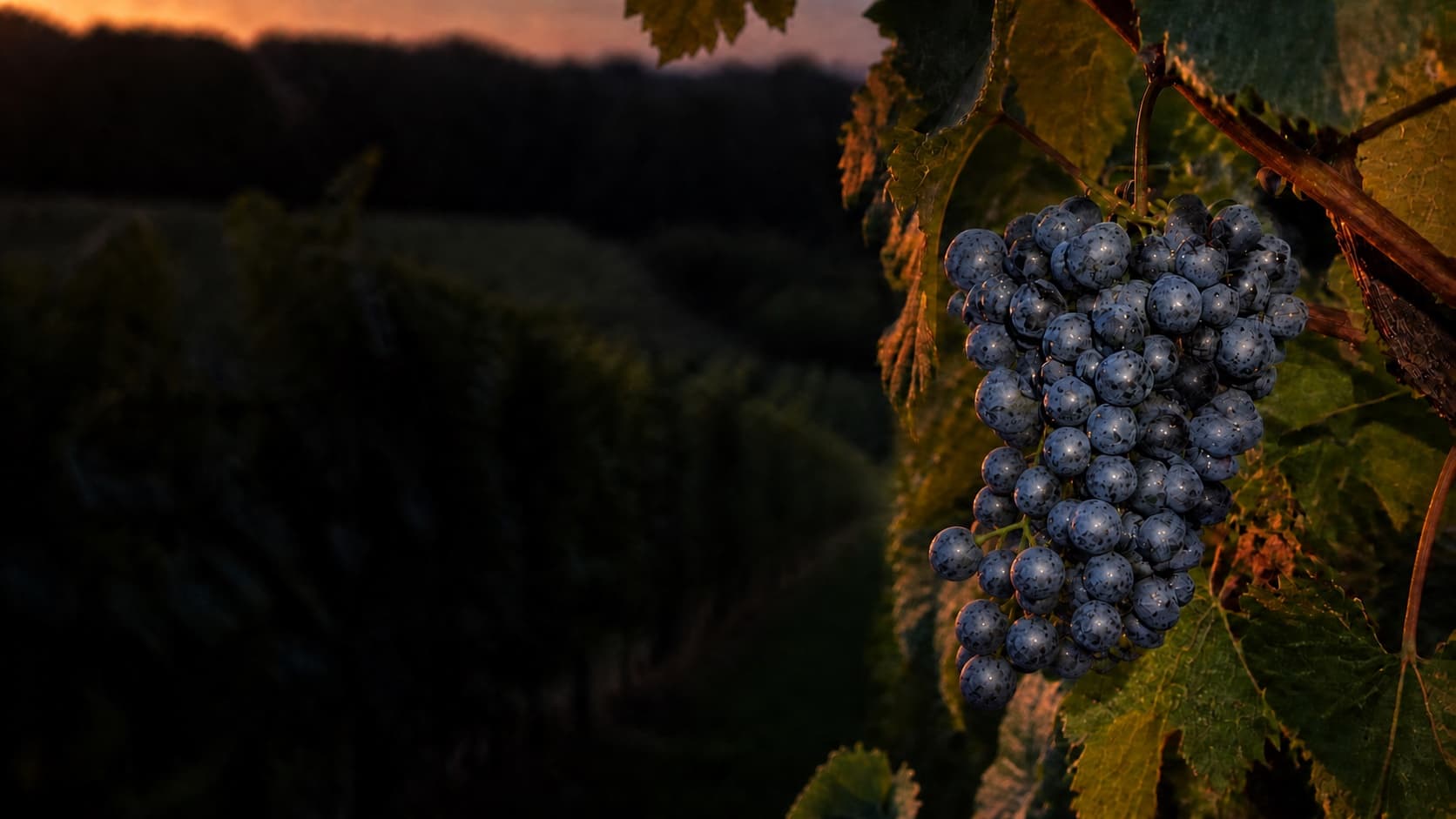
Zweigelt develops medium to large, conical and shouldered bunches. Oval berries have a thick, dark-blue skin, a fine bloom and juicy flesh.
Shouldered bunch A broad crown and tapering base create its typical outline.
Thick skin Protects the juicy berries and supports deep colour.
Open canopy Airflow around the shoulders helps protect compact fruit.
In the vineyard
Balance begins
with restraint.
Earlier than many classic reds, but rewards a patient harvest date.
Measured yields improve colour, concentration and structure.
Winter hardy, while early budding calls for care in frost-prone sites.
Aromatic spectrum
Fruit in the light.
Spice in the shade.
Young Zweigelt speaks of cherry and raspberry. With maturity come darker fruit, subtle spice, velvet tannins and a quiet chocolate finish.
At Talaska
Austrian balance.
Melsztyn depth.
On Talaska’s southern slopes, Zweigelt ripens in full light above the Dunajec Valley. It can stand alone as a supple red or form the vivid fruit core of a red cuvée.
Role in the collectionZweigelt 2024 · Royal Red Oak · Cuvée Rot
Botanical sources
Prepared from recognised ampelographic and viticultural sources, including VIVC, Julius Kühn-Institut and official wine-sector publications.
Variety index