The fruit reaches maturity in a rhythm suited to cool regions and shorter seasons.

Variety index
Talaska Vineyard · Ampelography 10/11
St. Pepin
Osceola, Wisconsin · ES 282 · released 1983
The north written into its lineage
Cold-climate resolve.
Fruit filled with summer light.
St. Pepin was bred by Elmer Swenson near Osceola, Wisconsin. The cross between E.S. 114 and Seyval Blanc carried the breeding number ES 282 and was introduced in 1983.
Created for the short, cool seasons of North America, it joins winter hardiness with fruit suited to fine white wine, while retaining gentler acidity than many other cold-climate varieties.
Variety passport
Its identity,
in six precise points.
- Origin
- Osceola, Wisconsin, USA
- Introduced
- 1983
- Breeder
- Elmer Swenson
- Parents
- E.S. 114 × Seyval Blanc
- Breeding number
- ES 282
- Flowers
- Pistillate · requires a polliniser
01
02
03
04
05
06
Anatomy of the variety
Pale berries.
A looser rhythm.
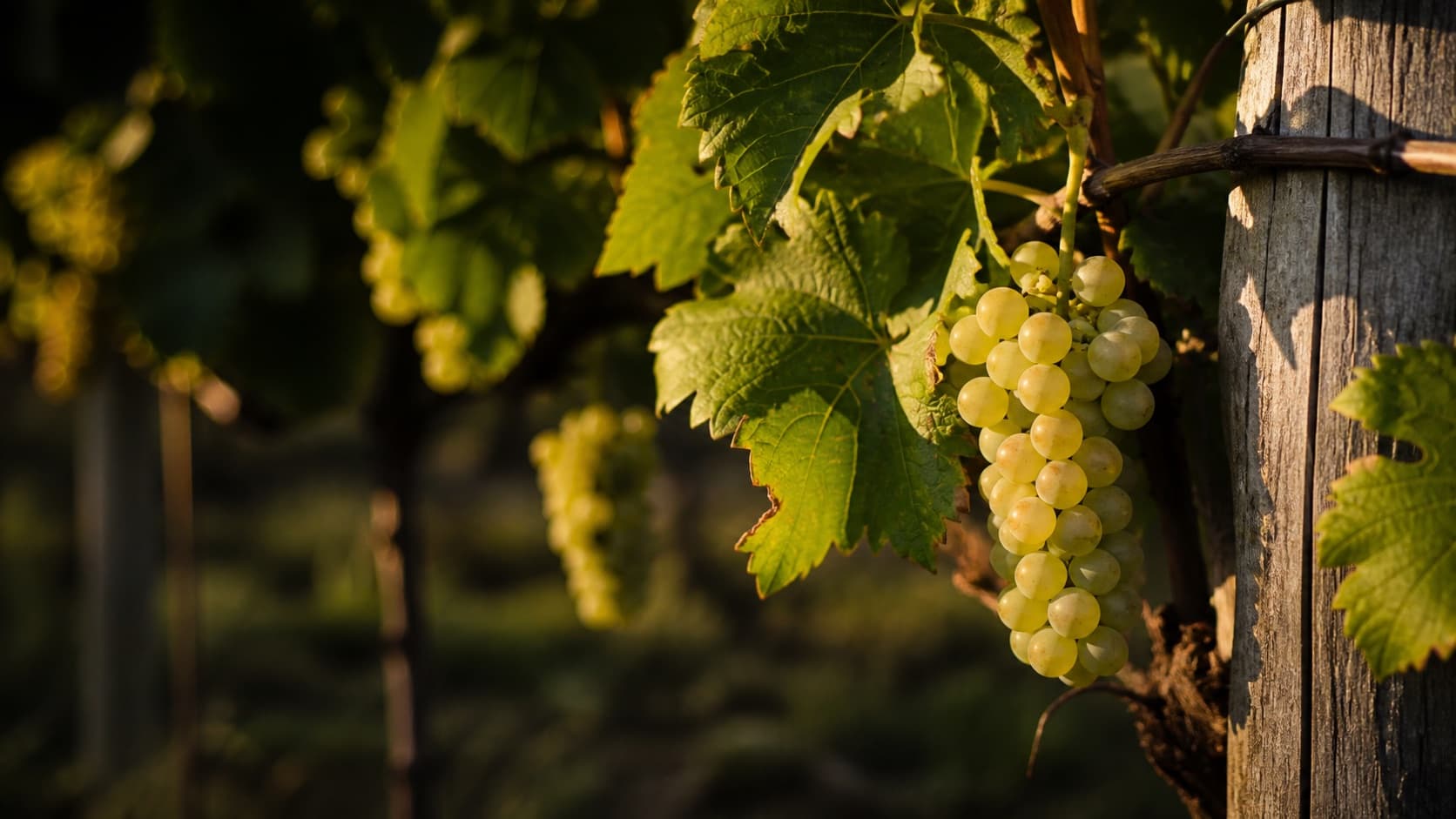
St. Pepin forms medium to large, conical and moderately loose bunches. Spherical, small to medium berries ripen evenly, moving from pale green towards translucent straw-gold at full maturity.
Conical bunch Moderately loose architecture leaves natural space between the berries.
Spherical berry Pale skins take on straw and soft golden tones as ripeness develops.
Winter hardiness Selected for short seasons and the severe winters of the American north.
In the vineyard
Vigorous growth.
Flowering needs company.
Energetic, fairly upright shoots create a naturally open canopy.
The flowers are not self-fertile, so a compatible polliniser must grow nearby.
The vine was selected to withstand substantially colder winters than classic European cultivars.
Aromatic spectrum
Pear and apple.
Flowers in cool light.
St. Pepin produces fruit-driven white wines with comparatively gentle acidity. Pear and apple can meet citrus freshness, a Muscat-like floral lift and a discreet honeyed finish.
At Talaska
Northern hardiness.
Melsztyn light.
On Talaska’s south-facing slope, St. Pepin receives the light needed for full ripeness, while airflow from the Dunajec Valley supports its moderately loose bunches. It brings a bright, fruit-led voice and the story of American cold-climate breeding to the collection.
Role in the collectionBright fruit · floral lift · gentle acidity
Botanical sources
Prepared from Foundation Plant Services at UC Davis, the original USPP5771P plant patent and the University of Wisconsin–Madison Extension review of cold-climate cultivars.
Variety index