Its short cycle is well suited to cooler, temperate sites.

An ancient Burgundian lineage
Delicacy in the fruit.
Depth in every nuance.
Pinot Noir is among Europe’s oldest cultivated varieties and has been associated with Burgundy for centuries. Its natural mutations include Pinot Gris and Pinot Blanc.
It is a variety that rewards precision. In the right place, it combines finesse, aromatic complexity and a remarkable ability to articulate its origin.
Variety passport
Its identity,
in six precise points.
- Origin
- Burgundy, France
- Family
- Historic Pinot family
- Type
- Red Vitis vinifera
- VIVC number
- 9279
- Ripening
- Early
- Synonyms
- Spätburgunder · Blauburgunder
01
02
03
04
05
06
Anatomy of the variety
Small berries.
Remarkable precision.
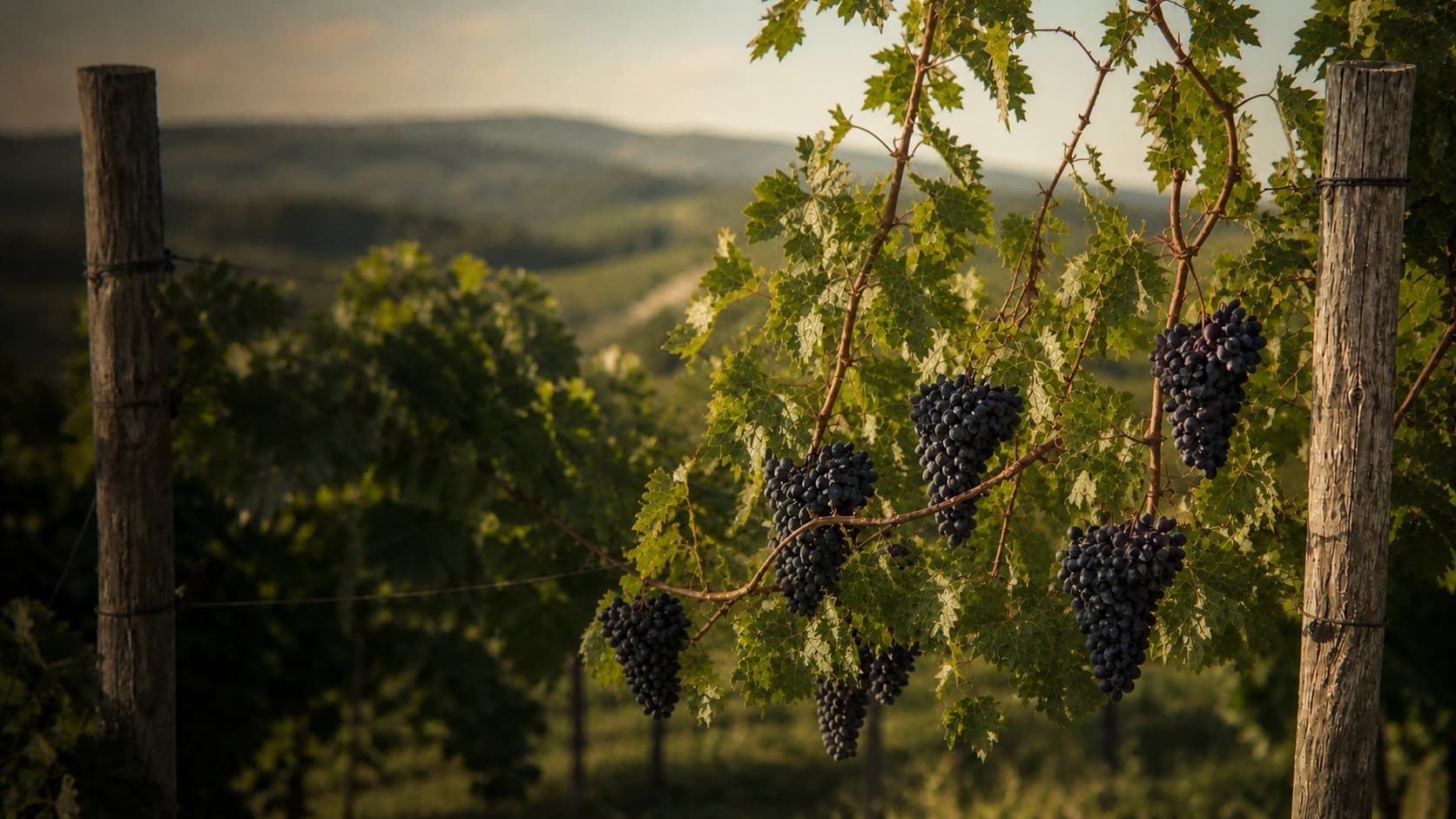
Pinot Noir forms small or very small, generally compact bunches. Fine-skinned blue-black berries demand close attention to airflow, light and the timing of harvest.
Small bunches A compact, regular silhouette is one of the variety’s defining features.
Fine skin Calls for gentle handling and a carefully judged harvest date.
Delicate nature A well-aerated fruiting zone helps protect its compact clusters.
In the vineyard
Measured yields.
Complete attention.
Fine fruit builds concentration while demanding meticulous care.
It is most expressive with restrained growth and limited yields.
These sites support its balance of finesse, fruit and structure.
Aromatic spectrum
Red fruit.
A woodland shadow.
Pinot Noir moves through cherry, raspberry and wild strawberry, gaining violet, dried herbs and an earthy woodland nuance with maturity.
At Talaska
Burgundian finesse.
Melsztyn freshness.
On Talaska’s southern slope, Pinot Noir receives abundant light while airflow from the Dunajec Valley helps retain freshness. Clay-limestone soils suit its search for balance between delicacy, fruit and structure.
Role in the collectionFinesse · red fruit · freshness
Botanical sources
Prepared from recognised ampelographic and viticultural sources, including VIVC, Julius Kühn-Institut and official wine-sector publications.
Variety index