It ripens between Silvaner and Riesling, at a rhythm similar to Pinot Blanc.

Riesling heritage, modern resilience
Northern precision.
A contemporary strength.
Johanniter was crossed in 1968 by Johannes Zimmermann at the State Viticultural Institute in Freiburg. Riesling was combined with the complex breeding line Seyve Villard 12-481 × (Ruländer × Gutedel).
Named in honour of its breeder, Johanniter retains a clear kinship with Riesling while adding good resistance to fungal disease and winter frost — qualities of particular value in cooler winegrowing regions.
Variety passport
Its identity,
in six precise points.
- Origin
- Freiburg, Germany
- Crossing year
- 1968
- Breeder
- Johannes Zimmermann
- Parents
- Riesling × SV 12-481 line
- Breeding number
- FR 177-68
- VIVC number
- 17127
01
02
03
04
05
06
Anatomy of the variety
A compact bunch.
The marks of ripeness.
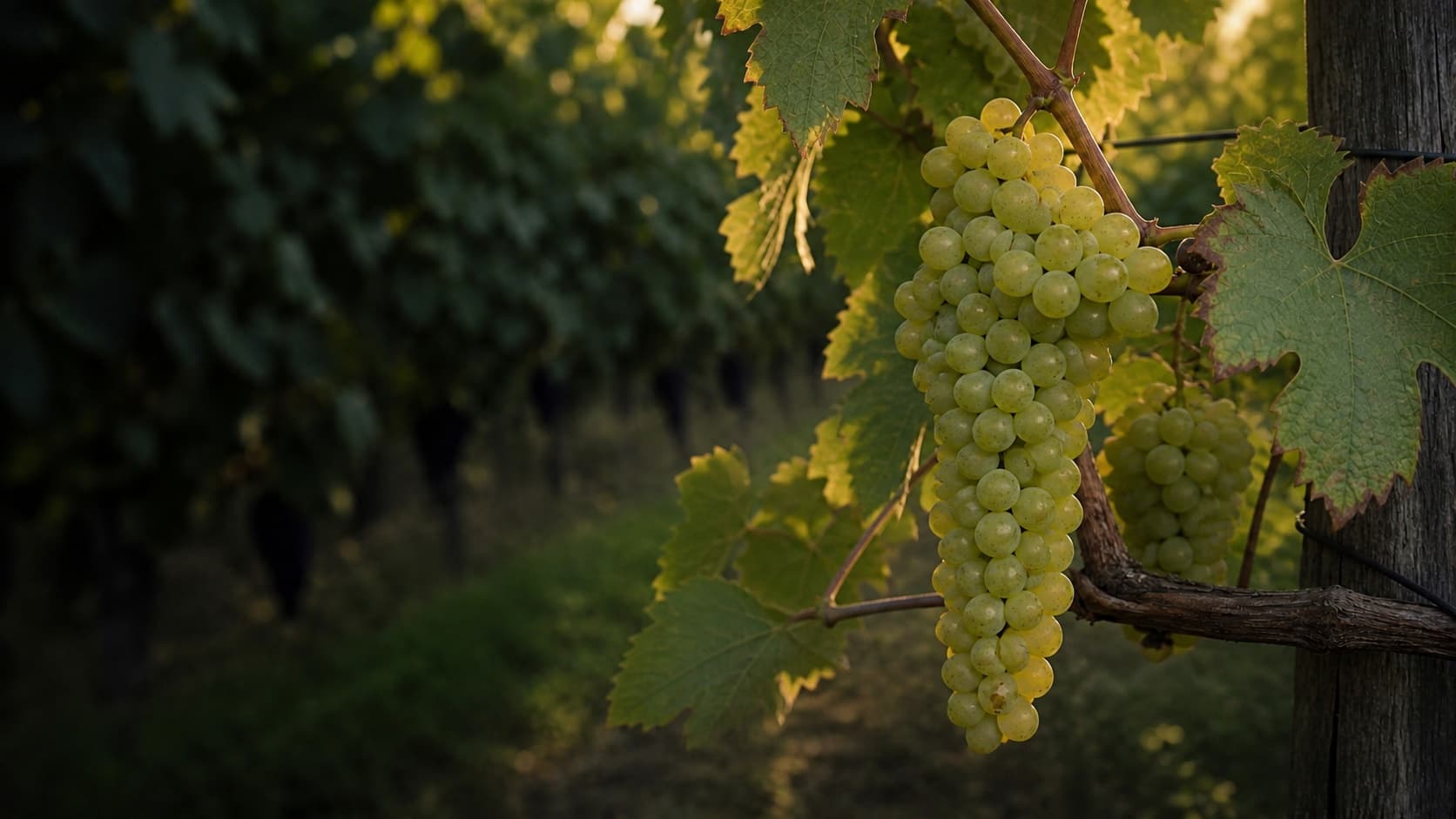
Johanniter forms medium to large, cylindrical and densely set bunches. Round, medium-sized berries ripen to green-yellow, developing the characteristic dark ripeness spots visible across their skins.
Cylindrical bunch An elongated, densely set outline is one of the variety’s most recognisable signs.
Green-yellow berry Round fruit retains subtle translucence and natural ripeness spots.
PIWI resilience Good downy-mildew and winter-frost resistance supports more responsible cultivation.
In the vineyard
Strong growth.
Ripeness before Riesling.
Upright, energetic growth is paired with relatively modest lateral-shoot development.
The variety crops consistently, making thoughtful yield control important for quality.
Good resistance to downy mildew and winter frost helps reduce protective pressure.
Aromatic spectrum
Pear and melon.
Mandarin in the shade.
Johanniter wines are generous and fruit-driven, stylistically poised between Riesling and Pinot Gris. Softer acidity carries pear, melon and a piquant suggestion of mandarin.
At Talaska
Freiburg thinking.
Melsztyn balance.
On Talaska’s south-facing slope, Johanniter can build full ripeness while airflow from the Dunajec Valley helps protect its compact bunches. Its fruit and gentler acidity broaden the white collection with a rounder, harmonious register.
Role in the collectionFruit · harmony · gentle freshness
Botanical sources
Prepared from the State Viticultural Institute Freiburg, variety documentation from the Julius Kühn-Institut and VIVC records.
Variety index